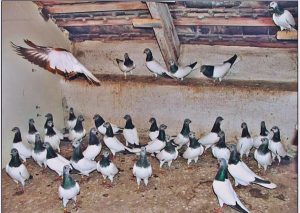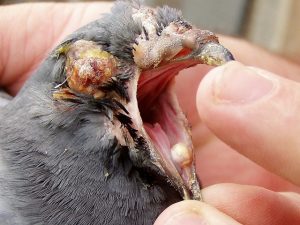
Dear Doctor! I have two questions for you. I have recently noticed a lesion on the plumage of several pigeons that have recently joined my flock, which I have not noticed before in my own birds. I have encountered the lesion before, but not in my own flock. Among pigeon fanciers such birds are known as “feather sick”. The lesion disappears after the autumn moulting and usually reappears in the spring, always in the same individuals. The lesion almost always appears on the front of the neck, in the crop region. It looks as if the feather of the pigeon has been worn off. (I saw a pigeon at a fair that was having a half-penny of feathers missing, probably for the same reason). I regularly read your books but I have not found anything on this (or maybe I just missed it…)
I enclose some photos. It is not supposed to be contagious, but I would like to know more about it, what causes it, can anything be done to prevent it…
The other problem I have encountered only to a lesser extent at the end of the breeding seasons. This year, however, it is occurring en masse. In many nests, one of the chicks is so far behind in development that it has to be culled. I suspect there is some disease lurking in the flock, I just don’t know what it is. Two weeks ago I found some pigeons with paratyphoid am.ong the adults. After that the whole flock was given enrofloxacin for ten days and then probiotics for days. Apparently asymptomatic, but the previously well-breeding pigeons are still only rearing one pigeon, because the smaller chicks either die or have to be culled.
Thank you for your reply. Yours sincerely, Stephen K. L

*
We receive many enquiries by e-mail and telephone about the above problem. Not only in our country, but also abroad. According to my Australian colleague and friend Dr Colin Walker, the lesion is caused by the pigeon regularly rubbing this part of its body against the edge of the feeder or drinker or other protruding object, effectively abrading these feathers, as Stephen, who asked the question, describes. However, Dr Walker did not describe why the pigeon rubs this part of its body.
It may be a coincidence that Stephen sent us two questions at the same time to help us solve the mystery. A connection between the topics of the two questions may be suspected…
First, let’s look at wear and tear itself. Is it really wear and tear, or is it the work of an external parasite? Or a feather development disorder caused by a circovirus or genetic defect?
Well, Stephen writes that the lesion disappears after the autumn moulting and then usually reappears in the spring. This shows that the moulting is normal, the new feathers develop normally, and the lesion reappears only months later. So, it is not a feather development disorder, and we can rule out a circovirus or genetic defect.
Many people have also reported that they have tried to treat the lesion with anti-parasitic drugs, but to no avail. This means that external parasites can be ruled out, all the more so because their activity is not usually confined to one place, but can appear all over the body.
If you look at the second photo, it does indeed look as if the feathers have been worn down nice and evenly. According to Dr Walker, it has been observed that these pigeons do rub this part of their body, so let’s just say that it is indeed rubbing wear. But why are these pigeons rubbing their crop?

The second question may help us to find out. Stephen has described what he has found in the flock, and it does indeed point to paratyphoid caused by salmonella. It is also interesting that his two problems occurred at the same time, with the setting of the alien pigeons. It is clear that the new pigeons brought with them a new strain of salmonella that infected the flock, hence the massive outbreak of paratyphoid during the breeding season.
We also know that there is a special form of paratyphoid known as “crop paratyphoid”. In this case, one of the main targets of salmonella is the crop, one of the symptoms of which is “slow crop”, i.e. delayed discharge of the crop, which is often unnoticed. In any case, as in other parts of the intestinal tract, salmonellae can also colonise in the crop permanently, causing permanent inflammation of the crop wall.
This inflamed crop wall obviously gives the pigeon a bad feeling, which it tries to alleviate by rubbing the crop against various objects.
On second thought, salmonella is not the only pathogen that can cause crop inflammation. We know very well that the prime target for trichomonads is the crop, so much so that there is hardly a pigeon in the world that does not have them in its crop. A small number of trichomonads, of course, do not cause trouble, but if they multiply, they cause permanent inflammation of the crop wall.
As there may be more than one pathogen involved, think about what other symptoms have been present in the loft. As Stephen has described, he has observed symptoms of paratyphoid, so he should obviously start treatment in that direction. However, if trichomonadosis (commonly known as “canker”) is also a problem in his flock, then he should treat for that as well.
According to Stephen, the spring, the time of pairing, is when the crop-rubbing starts again. This fact puts the suspicion on trichomonads. At this time the stress of pairing helps trichomonads to overgrow in the crop, which can lead to inflammation and rubbing of the crop.
Remember that even if you treat successfully, so that the inflammation and rubbing of the crop area stops, the feather deficiency will remain until the next moulting. In fact, even if the sensitivity of the crop has disappeared, some pigeons may continue to rub the area with less intensity, simply as a bad habit.
(Photos taken and sent by Stephen.)
*
Continuing the story
Stephen sent me these questions three years ago. I recently received a response from him, regarding the case. Here is an excerpt:
Since then, I have been giving the flock a preventive treatment against trichomonads every 3-4 months, with dimetridazole in winter, outside the breeding season, and ronidazole for 5-7 days in the breeding season. I do it this way because, if I remember correctly, you wrote in one of your books that ronidazole is less toxic and poses less risk to the chicks. I heard from a racing pigeon fancier that he treats his racing pigeons once a week for trichomonads. In my opinion, one-day treatments can lead to resistance… Fortunately, since I have been using these treatments regularly, I have not had any symptoms of feather deficiency, so trichomonads must have played a role.
*
You can find more information on these topics in my world-famous specialist books: