
One of our articles, “Missing feathers – lesion around the crop“, deals with the appearance of featherless areas above the crop. We received a lot of feedback on this article, many pigeon fanciers have encountered this problem, but almost all of them wrote that they could not solve it. Most of them put up with it, noting that the problem doesn’t seem that big anyway.
But there are other opinions. Some people take this problem seriously. A young homing pigeon breeder, M. Gondi, wrote to me a few months ago on this subject after visiting a homing pigeon show. He was also struggling with this problem and thought he would learn something about it at the show:
“Yesterday I was at the national homing pigeon show. I looked at a lot of pigeons and there were only a few breeders who did not have this problem. Everybody else had pigeons with the red skin on the crop area… I think most people don’t even look at pigeons normally… There were a lot of people at the show and I didn’t want to make anyone uncomfortable by asking such questions. Then I got a bird there from a very good breeder. First of all I looked at its neck. Of course there was the lack of feathers above the crop. At that point I couldn’t hold it in any longer (there were about 10 of us there) and asked who had ever seen this. They didn’t even know what I was talking about … They came over and looked at it and said they hadn’t even looked at it on their own pigeons. And I have seen this problem there in almost all the flock. They don’t seem to see it as a big problem, at all.
Before I go on to two very interesting and useful pieces of feedback, I would argue a little that the lack of feathers around the crop is not a particularly big problem. Of course, it’s not a life-threatening situation, but when you think about it, the appearance of a show pigeon is certainly spoiled if its plumage is not perfect. (Most shows exclude pigeons with feather defects on the grounds that they have parasites and are therefore contagious.)
The shortage of feathers in racing pigeons is also a serious factor. During flight, the greatest drag is created in the crop area. The feathers of pigeons and other birds capable of flight are arranged over the crop to form the least possible drag during flight. If this arrangement is disrupted by a lack of feathers, the body loses its streamlining and thus its drag increases enormously.
This extra drag is not good for your results in the race. It may not seem like a big disadvantage at first, but it is. To give a measurable example, engineers have shown that if you roll down one of your car’s side windows an inch and drive like that, you increase fuel consumption by 7%, even though it’s only a side window, not the front windscreen. If you drive without a windscreen, because it’s directly opposite the driving wind, the drag can increase several times. The pigeon’s crop is directly opposite the driving wind, so the lack or damage of feathers there will reduce speed very significantly, and increase the muscle work required.
Car manufacturers, especially racing car manufacturers, are spending millions of dollars to reduce vehicle drag by just one per cent. A shortage of feathers around the crop reduces flight performance by not one, but at least 5-20%, depending on the size of the shortage, due to the turbulence caused. A pigeon with a severe feather deficiency should not be raced. It is very annoying when one or more of your good pigeons cannot be entered because of a feather defect. Anyone who does send them to a race should not expect very good results, nor even many returning pigeons.
Specimens with just a little bit of a feather defect, just a little bit “ruffled”, will be entered, but without a chance. Even if they are only 1 or 2 % behind, it is a serious loss of time in the long run, especially in headwinds.
Let’s now turn to the cause of the development of feather deficiency. Let’s take a look at the feedback:
” …I can already see that some pigeons don’t have their feathers on that part like before… Out of curiosity, I cut off a bird and looked inside. It has a bloody bruised skin, above the crop, but nothing else can be seen. The crop itself is very nice and intact … They have beautiful feces, with lots of feathers, no sick pigeons…”

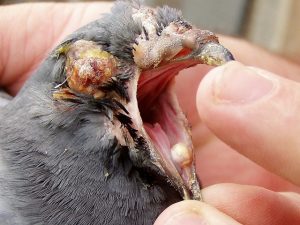
As described in the previous article, the feather deficiency is probably caused by the pigeon regularly rubbing its crop area against the edge of the feeder or drinker, or against some other object. The above feedback describes a bloody bruise. This is clearly a mechanical injury, so it may indeed be the cause. Why the pigeon is rubbing this area was also discussed in our previous article. We concluded that pathogens in the breast (e.g. trichomonads or salmonella) may cause the pigeon to feel unwell, irritated and therefore rub this area. Another feedback confirms this:
“Since then, I have been giving the flock a preventive treatment against trichomonas every 3-4 months, with dimethridazole in winter, outside the breeding season, and ronidazole for 6-7 days in the breeding season. Since I started these treatments regularly, I have fortunately not had any symptoms of feather deficiency, so trichomonas was certainly to blame. “
So we have found one of the causes, and that is trichomoniasis. However, other causes may be involved, perhaps also in pigeons. Certainly, the phenomenon of cannibalism is well known among poultry keepers, where for some reason (usually a lack of nutrients) poultry start pecking each other’s feathers. In many cases, it can go so far that not only the feathers but also the skin is pecked bloody, to the point of death! Pigeons may also develop this feather deficiency if they peck each other’s feathers for various reasons, e.g. stress due to overcrowding.
*
You can find more information on these topics in my world-famous specialist books: