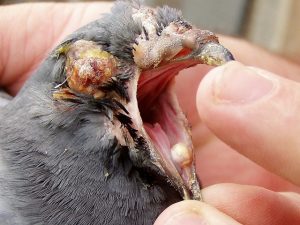
These parasites are widely prevalent. They belong to the group of arthropods: they include insects, e.g. bird lice; or arachnids, like mites or ticks. Their damage is varied and can be very serious. Their presence bothers the pigeons; they take nutrition away from the host body, and/or damage the plumage. They can be vectors for contagious illnesses, e.g. pox.
Blood-suckers siphon off nutrition directly from the host body. This can go as far as the host animal falling ill, displaying symptoms. Initially it is only the performance of the pigeon which is worse than usual, but later it can also lose weight, which is accompanied by anaemia. The pigeon tires easily and is bad-tempered. All these symptoms are worsened by secondary illnesses. The younger age-group reacts more sensitively to these parasites, too: a severe infection can even cause a high level of death amongst them.
Plumage damagers cause disorders in the growth of feathers, but also destroy the stock of already developed feathers. The pigeon’s plumage is incomplete, scraggy; certain feathers will be deformed. All this is at serious cost to flying performance.

The life of external parasites varies, and we must be aware of this for prevention to be successful. Some of them (e.g. itch-mites living in/under the skin, or feather lice) spend their entire lives on the host body, while others (e.g. blood-sucking lice) only visit their prey to feed (usually at night), hiding in the surroundings for the large part of the day.
The precise determination of the types of the various external parasites first takes place with a thorough visual inspection, for which it does no harm to use a magnifying glass. Certain parasites (e.g. itch-mites living in/under the skin) are not visible even like this, and so there is often need for additional techniques, like the microscopic examination of scraps of skin or parts of feathers. In the search for parasites we must examine the whole surface of the pigeon’s body, as different species have a penchant for residing in different areas of the body (e.g. scaly mites in/under the skin of the feet).

Just as in the case of intestinal worms, we require treatment of the flock here, too, and it is also necessary to rid the surroundings of parasites. The latter refers to the eggs laid down by the parasites, but also to the developed blood-suckers which spend the majority of their time hidden in the surrounding area.
Elimination of parasites has to be combined with a big spring clean, i.e. finding and removing the hiding places of parasites and their eggs. This can be followed by an efficient method of disinfection, which is not without its effect on other pathogens (e.g. bacteria) as well. Finally, the building of the loft and pieces of furniture must be sprayed or washed with special antiparasitic substances.