
In the last two weeks I have had poor results. Before that, the weather was bad, it rained a lot and my lofts wet a bit. My pigeons are showing mild respiratory symptoms. My friend suggested a course of doxycycline. Can you give me your opinion on doxycycline? I do not use many antibiotics but I think I have a justified problem now. Can I use it during the racing season?
*
Doxycycline is a good choice for the racing season. It has a broad spectrum, meaning it is good against many different pathogens. At the same time it is less toxic to the body and gut flora.
Doxycycline belongs to a family of tetracyclines, such as chlorotetracycline and oxytetracycline. These antibiotics are particularly effective against mycoplasmas and chlamydia, as well as against most of the bacteria responsible for respiratory diseases.
Doxycycline is usually given orally. Its absorption from the intestinal tract is affected by a number of factors. The pH (acidity or alkalinity) of the intestinal contents is not negligible for tetracycline, especially doxycycline. In acidic environments it is much better absorbed from the intestinal tract than in alkaline environments. When giving doxycycline to the flock, always add organic acid to the medicated drinking water – the simplest is apple cider vinegar or lemon juice.
When given orally, doxycycline is rapidly absorbed in acidic conditions, but the amount of intestinal contents will affect its absorption, so it should always be given on an empty stomach before feeding the pigeons.
When used, shock therapy is recommended, which means that the dose calculated for the whole day is given in as much water as the pigeons will drink in a short time.
Supplements containing lime should be removed when giving doxycycline, as the calcium in the lime neutralises the doxycycline – although to a lesser extent than other tetracyclines. Similarly, iron, magnesium and zinc can damage the active substance (iron water, unenamelled metal containers).
When using tetracyclines, it is advisable to boil the drinking water beforehand if the water in your area is very hard (if the detergent does not foam easily)! The hardness of the water is caused by the large amounts of calcium and magnesium in it, most of which can be got rid of simply by boiling the water.
Dosage:
0.2 gram (pure active ingredient!) per litre of drinking water, or 0.02 gram per kilogram of body weight, for 3-5 days. In more severe cases, treatment for 8-10 days is recommended.
In cases of ornithosis, a course of 4-5 weeks may be necessary.
Example: if you have doxycycline powder with a concentration of 10%, you need 2 grams of it per litre of water. It is better to calculate the whole daily dose per body weight, which is 2 grams per 10 kg of body weight of the 10% powder.
Unlike the other tetracyclines, doxycycline can also be used in kidney disease, e.g. in paramyxovirus disease, doxycycline can also be used to treat secondary bacterial infection.
However, doxycycline is not recommended for birds less than three weeks old.
Doxycycline is not harmful to performance so can be used during the racing season. It is less toxic to the liver and less harmful to normal gut bacteria than other tetracyclines.
Comment:
Although doxycycline originally had a good effect on coli bacteria and salmonella, unfortunately these pathogens are now mostly resistant to it. Doxycycline can therefore only be used as a targeted treatment against them, based on sensitivity testing.
Tip: Doxycycline can be combined very effectively with tylosin, thiamulin or chlorotetracycline for respiratory diseases – even during the racing season.
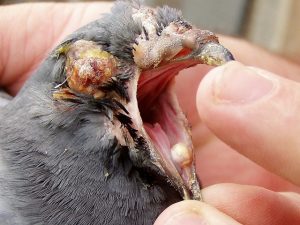
Tip: If doxycycline is not effective against the respiratory illness present, remember that trichomoniasis (yellow button disease) may be the cause. In this case, try to treat it with, for example, ronidazole.