
Question
Dear Doctor! I have a 3x2x2m loft with a sunbathing area of the same size and I never let my pigeons out of it. Wild birds and rodents cannot get in. The floor is concrete and I sprinkle it with yellow sand. For external parasites I use bath salt 1x a week and SH-Ivermectin spot on every six months.
Why did my pigeons get smallpox? If I am doing something wrong please let me know, any advice is welcome. What should I change?
Should I brush the wet form of smallpox with Betadine solution? If so, what technique do you suggest I brush with? In what proportion should I dilute the Betadine so as not to spoil it.
I do not want to vaccinate my pigeons with anything, I want to keep them healthy with natural substances. With thanks Gabriel W. D.
*
Answer
Pox virus in pigeons is spread mainly by blood-sucking arthropods. As the climate warms in most regions, new arthropod species are appearing in places where they did not previously exist. And native arthropods are multiplying in increasing numbers. As a result, diseases spread by blood-sucking arthropods are becoming more common.
The other bad news is that the pox virus remains infectious for a very long time, for many years, in the outside world, including in the loft, in the yard. Therefore, once they have entered the loft, they can remain infectious for a very long time.
Pox can flare up even if the pigeons never leave the loft. All it takes is one small blood-sucking insect crawling into or flying into the loft. If this arthropod has ever bitten, say, a wild pigeon infected with pox, it has become a virus carrier. It carries the virus, brings it into the loft, bites a pigeon – and the disease is in the flock. It then spreads rapidly within the flock, mainly via blood-sucking arthropods that migrate from one pigeon to another, spreading the virus. The virus is also shed in large quantities from pox rashes and remains infectious in hidden corners of the loft for years.
Sometimes we ourselves spread the pox virus and many other pathogens quickly and reliably in the loft when we vaccinate all our pigeons with a vaccination gun without changing the needle. (And maybe even the neighbour’s pigeons.)
.

Severe pox; rashes, outgrowths on the head and in the oral cavity. Permanent damage to the eyes.
Treatment
As it is a virus, antibiotics are ineffective against it. Pox rashes and outgrowths can be treated with a iodine solution. Skin rashes can be treated with concentrated Betadine, and those in the oral cavity with water diluted half and half. It is best to apply Betadine to the area using an ear cleaning stick. This treatment will not make the outgrowth go away any faster, but less virus will be shed. It may prevent secondary invasive pus-causing bacteria from aggravating the situation further by causing purulent dermatitis.
.
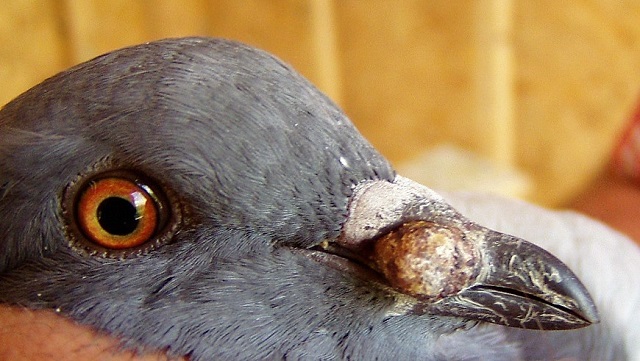
Big pox build-up. Similar outgrowths may also occur inside the oral cavity, obstructing breathing and swallowing
.
The most important thing with pox is prevention. These are:
1. keeping arthropods (especially mosquitoes) away from the loft
2. regular eradication of blood-sucking mites and lice inside the loft
3. strengthening the skin’s resistance
4. vaccination
Let’s look at these in more detail:
1. Keeping vector arthropods away from the flock
Pox virus and many other pathogens can be spread by various mosquitoes. They can also be controlled with mosquito nets. The area around the loft and the yard can be sprayed regularly with a mosquito repellent that is not harmful to warm-blooded animals or humans.
2. Regular extermination of blood-sucking mites and lice inside the loft
Bath salts will not particularly affect blood-sucking parasites, and treatment with ivermectin every six months is too little. This should be done at least every three months, using not only ivermectin but also other products such as permethrin. Do not just disinfect the pigeons, but also the loft! During the warm seasons, when arthropods are a greater threat, use even more frequent control products.
3. Strengthening the skin’s resistance
Regular intake of skin-protecting vitamin A is important, as is the provision of trace elements. However, vitamin A should not be overdosed, as too much causes peeling and hardening of the skin, which is conducive to the pox virus.
4. Vaccination
There is a vaccine, but unfortunately it is not available in all countries. Always vaccinate all pigeons, do not leave unvaccinated pigeons in the loft.
Attention! Do not use an inoculation gun! Use a new sterile needle for each pigeon, otherwise you are guaranteed to infect your whole flock with viruses and bacteria.





